
The laptop chip landscape just got significantly more competitive. On June 1, 2026, Nvidia CEO Jensen Huang took the stage at Computex in Taipei and announced something that genuinely surprised the industry: Nvidia is now building laptop processors. Not a discrete GPU, not an external AI accelerator complete CPU-GPU system-on-chip that powers the entire computer.
The chip is called RTX Spark, and it puts Nvidia directly in competition with Apple Silicon for the first time. The Apple M5 Pro the chip powering today's MacBook Pro is the most natural comparison point. Both chips target the premium laptop market, both are built on 3nm processes, both use unified memory architectures, and both make serious claims about AI performance.
So how do they actually compare? Here is a detailed breakdown based on confirmed specifications and the first available benchmark results.
Architecture: Two Very Different Approaches to the Same Goal
Before getting into the numbers, it helps to understand how differently Nvidia and Apple approached chip design here.
The RTX Spark is a 70-billion-transistor SoC built on TSMC's 3nm process, fusing two chiplets into one package large Blackwell GPU chiplet on one side and a MediaTek-designed CPU and I/O chiplet on the other. The two sides are connected by Nvidia's NVLink-C2C interconnect at 600 GB/s, which Nvidia describes as roughly 5x faster than PCIe Gen 5 at substantially lower power draw.
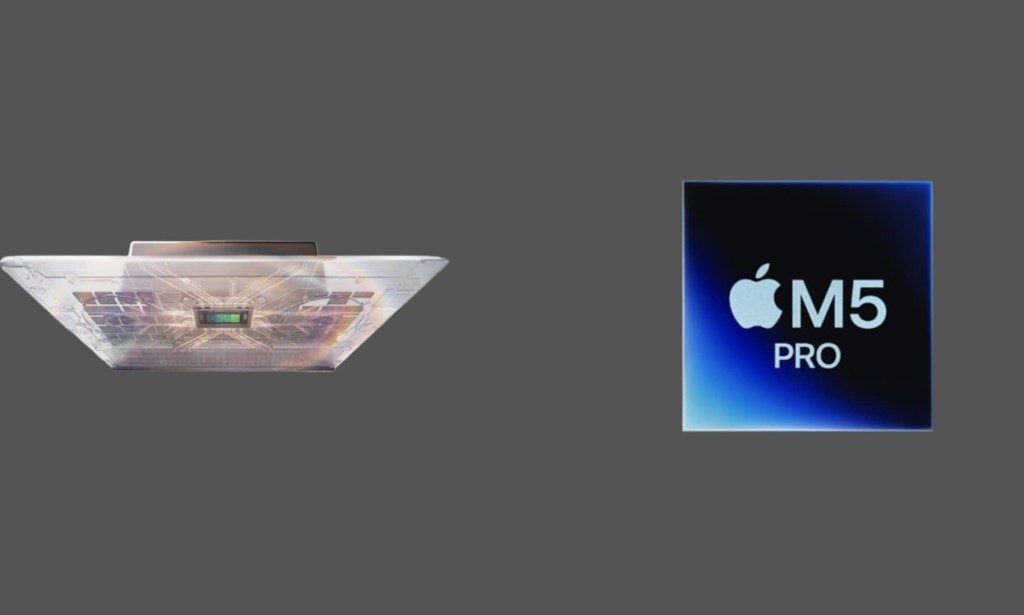
Apple's M5 Pro takes a different path with what the company calls its Fusion Architecture two 3nm dies connected into a single SoC using advanced packaging, bringing together a high-efficiency CPU, scalable GPU, Neural Engine, Media Engine, unified memory controller, and Thunderbolt 5 into one tightly integrated design.
Both chips share memory between the CPU and GPU design principle Apple pioneered with M1 and Nvidia is now adopting for its laptop platform. The execution, however, differs in meaningful ways.
CPU Performance: M5 Pro Holds a Real Lead
The RTX Spark uses a 20-core Grace CPU co-developed with MediaTek, combining ten Cortex-X925 performance cores with ten Cortex-A725 efficiency cores configuration familiar from high-end smartphone chipsets, scaled up for laptops.
The Apple M5 Pro features an 18-core CPU built on Apple's Fusion Architecture, using 6 super cores alongside a mix of performance and efficiency cores. Despite having fewer total cores, the M5 Pro's per-core efficiency tells a different story in real-world workloads.
The first meaningful data comes from a Clang compile benchmark the kind of sustained, heavily threaded developer workload that reflects real professional use. The results place RTX Spark at a score of 43,149, while the standard Apple M5 scored 27,996, making the RTX Spark roughly 54 percent faster in this test. That's a convincing win for Nvidia against the base M5.
However, the M5 Pro comparison shifts the picture. The 15-core M5 Pro scored approximately 46,374 placing it around 7 percent ahead of the RTX Spark. The 18-core M5 Pro pushed that to 55,165, putting it roughly 22 percent ahead of Nvidia's chip in the same test.
The reason comes down to architecture. Even with 20 cores, Nvidia's Grace CPU uses older-generation Arm designs, while Apple's super cores deliver higher individual core performance. In sustained parallel workloads, the M5 Pro maintains a measurable CPU edge though for everyday tasks, the difference between these chips will be completely invisible to most users.
GPU: Nvidia Brings CUDA, Apple Has Efficiency
The RTX Spark integrates an NVIDIA Blackwell GPU with 6,144 CUDA cores and fifth-generation Tensor Cores with FP4 precision. This is the same Blackwell architecture powering Nvidia's data center products, brought into a thin laptop chassis.
The Apple M5 Pro features a GPU built on the same next-generation architecture introduced with M5, with graphics performance up to 20 percent faster than the previous generation and ray-tracing performance improving by up to 35 percent. For professional creative workflows, the M5 Pro GPU is excellent and deeply optimized for every major Apple-platform application.
The fundamental difference here, though, isn't benchmark numbers it's the software ecosystem. The RTX Spark runs the full CUDA software stack: every AI research tool, scientific computing framework, and professional creative application built on CUDA over the past two decades works natively. PyTorch with CUDA, TensorRT, professional 3D rendering tools, and the entire PC gaming catalog all run on RTX Spark without compromise.
Apple's Metal API is highly capable within the Apple ecosystem, but it has no equivalent to CUDA's depth in AI research, enterprise workloads, and developer tools. For anyone whose work depends on CUDA, the RTX Spark's GPU story is categorically stronger.
AI Performance: RTX Spark's Clearest Advantage
Nvidia claims RTX Spark delivers up to 1 petaflop of FP4 AI compute enough to run 120-billion-parameter language models locally, with context lengths up to one million tokens.
Apple's M5 Pro delivers over 4x the peak GPU compute for AI compared to the previous M4 Pro generation, with Neural Accelerators embedded in each GPU core. Apple's approach distributes AI compute across the Neural Engine, GPU Neural Accelerators, and CPU AMX units, with CoreML routing tasks to whichever compute unit handles them most efficiently.
The result is highly power-efficient AI inference for Apple Intelligence workflows and on-device tasks. However, it does not match the raw throughput available through CUDA and TensorRT on the RTX Spark for workloads that explicitly use those frameworks.
For researchers running large language models, or developers building AI pipelines with standard industry tools, the RTX Spark's 1 PFLOP claim backed by the full CUDA ecosystem is a genuinely significant advantage.
Memory: Matched on Capacity, Different on Bandwidth
The RTX Spark supports up to 128GB of LPDDR5X unified memory at up to 300 GB/s of bandwidth, shared coherently between the CPU and GPU.
The Apple M5 Pro supports up to 64GB of unified memory at 307 GB/s of memory bandwidth making it essentially tied with the RTX Spark on bandwidth, but capped at half the maximum capacity. To reach 128GB on Apple Silicon, you need the M5 Max, which delivers that capacity at up to 614 GB/s more than double the RTX Spark's bandwidth figure.
When comparing the M5 Pro to the RTX Spark specifically, memory bandwidth is effectively a draw. The RTX Spark wins on maximum memory capacity at this tier. If the M5 Max enters the comparison, Apple pulls well ahead on bandwidth for workloads where that matters most particularly local LLM token generation.
Software Ecosystem: Maturity vs. Opportunity
This is the most important practical consideration for most buyers.
The RTX Spark arrives with the full CUDA software ecosystem and eight confirmed OEM launch partners ASUS, HP, Microsoft, Dell, Lenovo, MSI, and others shipping RTX Spark-powered laptops in autumn 2026. Nvidia and Microsoft are building the platform together, introducing NVIDIA OpenShell and the NVIDIA Agent Toolkit for local AI agent workflows on Windows. Nvidia has also committed to a three-generation chip roadmap Grace Blackwell, Vera Rubin, and Rosa Feynman signaling serious long-term investment.
Apple Silicon, however, has a multi-year head start on software optimization. Every major creative application Final Cut Pro, Logic Pro, Lightroom, DaVinci Resolve, Xcode is deeply tuned for Apple Silicon. Battery life on MacBook Pro is class-leading. The ecosystem is mature, refined, and predictable through several chip generations.
First-generation Windows ARM platforms have historically carried some software compatibility uncertainty at launch. The RTX Spark will likely be better than any previous Windows ARM release but buyers should account for that early-adopter reality when evaluating the platform against something as settled as M5 Pro-equipped MacBook Pro.
Availability and Pricing
The Apple M5 Pro is available right now in the MacBook Pro, starting at around $1,999 for the 14-inch base M5 Pro configuration.
The RTX Spark is shipping in laptops in autumn 2026. OEM pricing has not been officially confirmed, but the hardware profile strongly suggests these will be premium-tier products landing in similar price territory to MacBook Pro.
RTX Spark vs Apple M5 Pro: Head-to-Head Summary
| Nvidia RTX Spark | Apple M5 Pro (18-core) | |
| Process | TSMC 3nm | Apple 3nm |
| CPU Cores | 20 (Arm Grace) | 18 (Fusion Architecture) |
| GPU | Blackwell, 6,144 CUDA cores | Up to 20-core Apple GPU |
| Memory | Up to 128GB LPDDR5X | Up to 64GB |
| Memory Bandwidth | ~300 GB/s | 307 GB/s |
| AI Performance | 1 PFLOP FP4 | 4x vs M4 Pro gen |
| CPU Benchmark (Clang) | 43,149 | 55,165 |
| Software | CUDA, Windows ARM | Metal, Apple ecosystem |
| Availability | Autumn 2026 | Available now |
Which One Is Right for You?
The M5 Pro and RTX Spark serve overlapping but distinct audiences, and being honest about that distinction matters.
If you work within the Apple ecosystem, depend on macOS-native applications, and value industry-leading battery life with deeply refined software, the M5 Pro in MacBook Pro is the most complete professional laptop chip available today and it's available right now.
If you are an AI developer, machine learning researcher, or CUDA-dependent professional who works on Windows, the RTX Spark represents the most compelling Windows laptop chip ever announced. The combination of 1 PFLOP AI compute, 128GB unified memory, and native CUDA on a thin laptop is genuinely new. The trade-off is that it doesn't ship until autumn and carries the typical uncertainties of a first-generation platform.
Neither chip makes the other irrelevant. The fact that this comparison is genuinely competitive is itself the most interesting thing about Nvidia entering the PC market and it's only going to get more interesting from here.

You must be logged in to post a comment.